

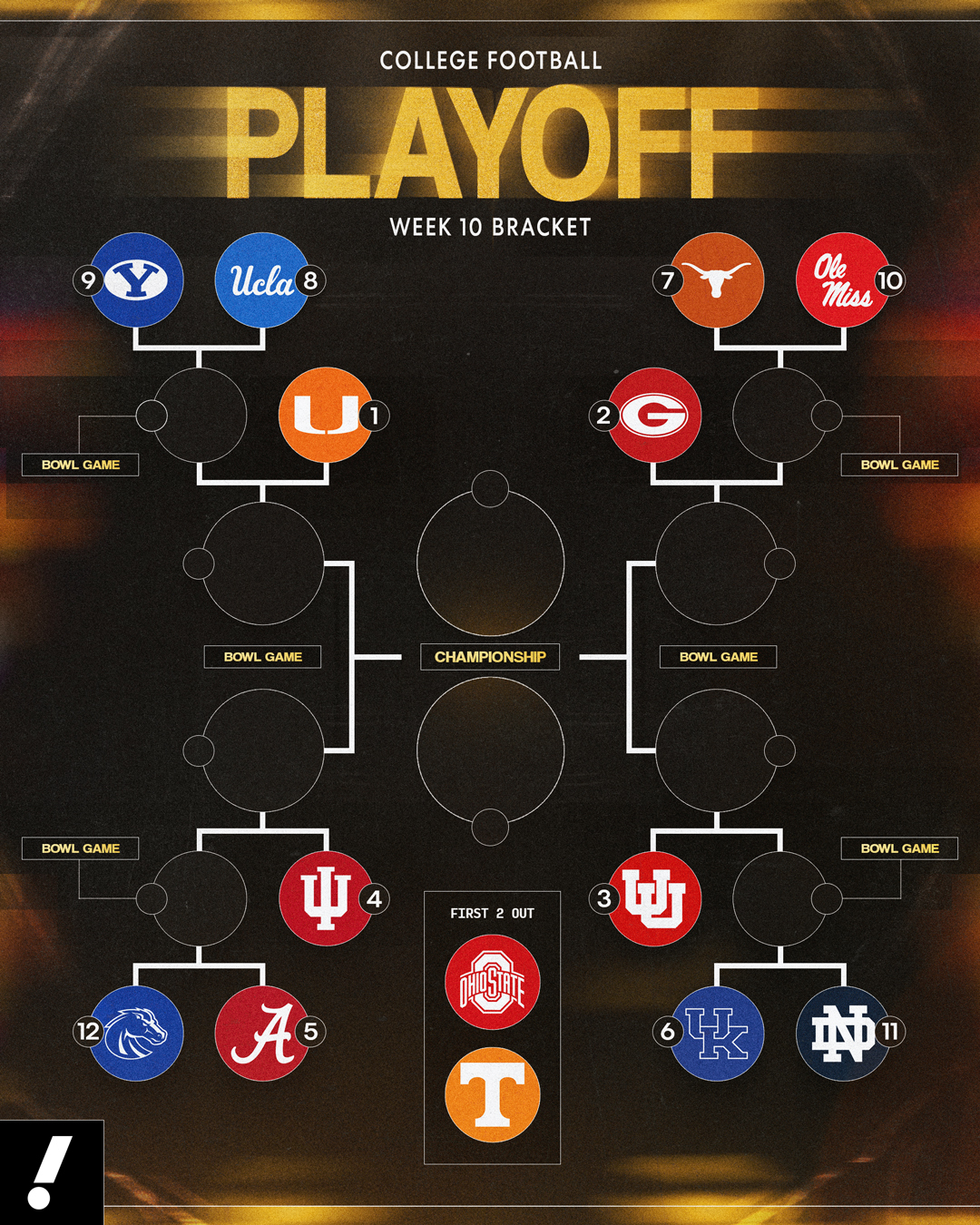
We are just hours away from the 2026 season’s first College Football Playoff ranking reveal which means it’s time for some bracket breakdowns.
The much maligned College Football Playoff Selection Committee will convene in an undisclosed 4-diamond hotel’s conference lounge, decide who gets to be happy, sad, or angry for one week at a time for the next several weeks. My job? Telling you who will be happy, sad, or angry before they do. Here’s what we know they value: strength of record, strength of schedule, on-field talent, and a team’s record. To a lesser degree, and typically later in the season, how a team is actually playing will be used to assist in deciding seed. This, however, cannot be found from the Committee’s protocol site, it merely states “There will not be one single metric to assist the committee. Rather, the committee will consider a wide variety of data and information.” read into that what you will and remember: the criteria shifts as they need it to.
VOLS’ PATH FORWARD: JUST WIN
Tennessee has a couple of paths forward, but the most straight-lined path they have to follow is that they have to win out. Winning out sees wins over Kentucky, at Texas A&M, and against LSU. Simply put, it will be incredibly difficult, but it will be incredibly fruitful. The loss at South Carolina eliminated a lot of their margin for error, and they must beat Kentucky to stay alive, those are two facts. There’s two reasons for this. Firstly, a loss immediately after the first unveiling of the CFP rankings would likely register the Vols as a back-of-the-brain set and forget team for, say, the ReliaQuest Bowl rather than an at-large. A committee is making these decisions, and recency bias will influence the next ranking heavily. One could argue losing now would help Tennessee, but that brings me to my second point. If Tennessee has any hope of getting in the playoff as a three-loss team, it will likely have to be a loss to a 2-loss LSU who appears to be steamrolling their way through the end of their season. Long story short, just win and worry about the rest later.
THE LOCKS
As things stand today, there are six teams with odds of 70% or greater to make the CFP: Miami, Indiana, Georgia, Notre Dame, Utah, and Ohio State. Two of these teams are not a lock, and we’ll get to them last. I wanted to take a look at the six teams here, their paths in getting here, and their avenue forward as we head towards December.
**DISCLAIMER: Rankings on the graphics next to the team name are from my Top 25 released earlier in the day. My personal formula will have little predictability towards the CFP. The graphics are merely helpful! Linked HERE**
70% Club
MIAMI HURRICANES: 8-0 (6-0 ACC)

Miami currently sits at the highest CFP probability in the country at 98.5%. An early season win over Wake Forest has only seasoned itself deliciously for the ‘Canes, but it remains Miami’s lone quality win as their win over Pitt has serious caveats. The conversation now surrounds whether an overqualified Miami team has just been seasoning up for the CFP or will their lack of high-end competition punch them in the mouth come December. That being said, Mario Cristobal is looking to make a legitimate push towards not just getting back to the National Championship game, but winning.
WHY THEY CAN WIN: Miami’s offense has been incredibly efficient. 99th percentile in passing success rate, 99th percentile in yards per dropback, and Malachi Toney continues to be one of the biggest game breakers in the sport. If Mensah gets enough time, and he typically does, he and Toney will pick apart just about any defense they’ll see.
FATAL FLAW: As much as the offense is great, it also has kryptonite level struggles. Miami, despite its unbelievably soft schedule thus far, can find themselves in disadvantageous third down and distance situations because of their inability to run the ball at times. Ohio State and Miami have the exact same rushing success rate this season, tied for 48th in the country, and this will put pressure on Darian Mensah to make throws against better defenses come playoff time that he hasn’t shown the ability to make with consistency. Miami has also not seen much resistance on offense, yet their defense has been hemoragging points and yards lately. The Hurricanes have surrendered 93 points over their last three against FSU, Pitt, and North Carolina, allowing over 400 total yards of offense in each. Both FSU and Pitt rank outside the top 50 in offensive success rate, and Pitt’s star quarterback Mason Heintschel didn’t play.
INDIANA HOOSIERS: 8-1 (5-1 B1G)

An injured Josh Hoover has left Indiana’s quest to repeat as champions in doubt, among other things. Hoover suffered a shoulder injury against Ohio State, and him not being at 100% has proven itself costly to IU’s offense as they’ve mustered just 36 points total in the two games since. Suffice to say, Cignetti has his work cut out for him. The flip side here is Indiana has two blessings in disguise working in their favor. Their loss to Ohio State is not hurting them because the Buckeyes, now without Julian Sayin and losing to USC, dropped below IU in the Big Ten standings despite handing the Hoosiers their lone loss. A massive game looms against a USC team coming off its biggest win under Lincoln Riley.
WHY THEY CAN WIN: The answer here is pretty simple. They can’t…right? Unlike last season, the roll of the dice just simply isn’t coming up IU. The Hoosiers’ offensive line has taken a major step back this season, and the aforementioned injury to Josh Hoover will only linger as they finish out conference play. However, Cig is still coaching the team, Haines is still the defensive coordinator, and as long as those two are scheming up that defense, you’ll still have to score against Indiana to win.
FATAL FLAW: Again, it’s really about Josh Hoover. Indiana cannot win without a healthy Hoover; they simply do not have the horsepower outside of their gunslinger to get it done with consistency in spite of their weapons in Becker and Marsh out wide. The defense can try and drag teams into the mud and make them play there, but there are far better teams out there than what they’ve seen thus far and struggled with.
GEORGIA BULLDOGS: 7-1 (5-1)

Despite a stunning home loss to Auburn, Georgia has largely avoided the cannibalistic SEC thus far, sitting pretty at the top just like they seemingly always do. Georgia’s ability to lean on opponents until they run out of gas and make mistakes has served them well thus far. Led by Gunnar Stockton, Dwight Phillips Jr, and Nate Frazier, Georgia’s ground attack has been potent, rushing for 175+ yards in six of their eight games and averaging 5.9 yards per carry. Georgia was my national championship pick coming into the season, and they’ve given very little reason to turn on that now.
WHY THEY CAN WIN: Georgia creates havoc on defense, and they largely do not turn the ball over. Combined with high-end efficiency on the ground and a multi-year starting quarterback, the Dawgs have a recipe to make up for a very young team losing too early last season. Georgia’s defense has created 15 turnovers thus far, and they are top five in the nation in opponent’s average 3rd down-and-distance. On the flip side, their offense is top five in average 3rd down-and-distance, often staying ahead of the sticks, churning clock, and punching it in for points.
FATAL FLAW: Lack of explosives has been the name of the game thus far, huh? Simply put, Georgia’s offense is built to work the ball down the field two or three plays at a time, but their defense can get overaggressive, and it’s led to one of the most prone units to explosive downfield plays in the country. There are a lot of quality defenses among the best teams that Georgia is likely to see, and one big play against their defense could flip the entire script.
UTAH UTES: 8-0 (5-0)

Utah is America’s team*.
(*you must dislike Michigan)
The Utes have proven what many have felt all along: Kyle Whittingham was getting fired, and Michigan hired a fired coach. Karma works in very funny ways.
WHY THEY CAN WIN: Led by Dev0n Dampier, Utah’s lethal ground attack has seen its passing game come nicely alongside it. Dampier has multiple passing touchdowns in all but one game, and he adds a very strong wrinkle into this top-10 rushing attack. Utah defensively has been strong enough to not be close to a weakness, and their ability to create turnovers and negative plays is arguably the team’s biggest strength.
FATAL FLAW: Utah is well-rounded, they’ve dominated just about everyone, neutralized Houston’s explosive offense to its worst game of the season, and look primed to take on their tougher back third of the season (BYU, @ Arizona). So, what’s the cause for concern? Big plays. All the bad ones. Despite being an advantageous group when it comes to opponent 3rd down-and-distance, Utah’s passing defense can be picked apart, and on the flip side, Devon Dampier, while explosive and dynamic, leads the Big 12 in turnovers. Utah’s biggest flaw last season in its two losses against Texas Tech and BYU was surrendering multiple turnovers in each game, and they’ve committed multiple turnovers in four straight games this season, despite lopsided results in three of those games. Above all of that, it may still be difficult for the Big 12 to make a case for a second or third depending on what happens down the stretch with Utah. Odds are more against them should they drop a game than anyone else here.
OHIO STATE IS NOT GOING TO BE 70% FOR LONG
Ohio State is at a crossroads, and Ryan Day is too scared to take the correct route. The Buckeyes appear to be without Julian Sayin (shoulder) for the rest of the season. His backup, Luke Fahey, a *checks notes* three-star true freshman, has taken the reins for the remainder of the season. Ohio State lost 30-18 in the rain in Los Angeles to USC on Halloween night, and Fahey did not play well. He was also far from their biggest concern. USC is not a good rushing team while Ohio State’s rush defense has been a strength since a terrible performance at Illinois. USC took whatever they wanted from the Buckeyes on the ground and converted on 40% of their third downs. A much bigger issue reared its ugly head once again as Ohio State had the ball for nearly 40 minutes of game time on Saturday despite being down by two scores for almost the entire game.
Clock management has been a sore spot for the Buckeyes for a couple seasons now, and it largely comes down to personnel and style of play. For whatever reason, despite transferring in five-star Julian Sayin before last season, landing Devin McCuin in the portal, bringing in freshman 6-foot-6 five-star Chris Henry Jr, and most notably with Jeremiah freaking Smith on the roster, Day chooses to operate one of the slowest offenses in the nation, opting for possession and control over explosives and points as if Todd Boeckman were still under center. This weird obsession coincides with college football’s clock rules changes, and Day has veered way too far to the right of that into deeply conservative territory, and instead of straying from it, he’s only tripled down, and you need look no further than Saturday for proof. Down 27-12 with under eight minutes left in the 4th quarter, Ohio State embarked on a 13 play, 80 yard touchdown drive that drained five minutes and 45 seconds off the clock. Ohio State was often snapping the ball with under 15 seconds on the play clock, routinely huddling between plays. It’s as if the ultra-programmed Ryan Day still can’t fathom that his team can lose a game. This ultimately led to Ohio State foolishly going for two with just over two minutes left, failing (they’ve yet to convert a 2-point conversion under Ryan Day), and found themselves still down two possessions, now with 130 seconds left instead.
After the game, Ryan Day said he thought their clock management was “…fast enough, we were efficiently moving it”. Day has struggled to see the forest through the trees routinely as a head coach, and his biggest flaws cornucopia into one giant flaw: he never learns from his mistakes. Ohio State is now 6-4 over their last 10 games. Just one win over a top 10, playoff contending team. Hard to even imagine, all things considered, and it’s the first time that’s happened since 2004, but Day failed to capitalize on the golden ticket out of a hot seat he had in winning a national championship. Look no further than his staff hires immediately after that. Ultimately, Ryan Day is not close to the coach he is perceived to be, and Ohio State will now have to lay in the bed its made on the recruiting trail and in development. They will not make the playoff.
Source: Yahoo Sports



Sign in to join the conversation.
Comments, replies, Roars, reports, and followed-thread notifications use your verified Rally & Roar account.
Sign in or create an account